
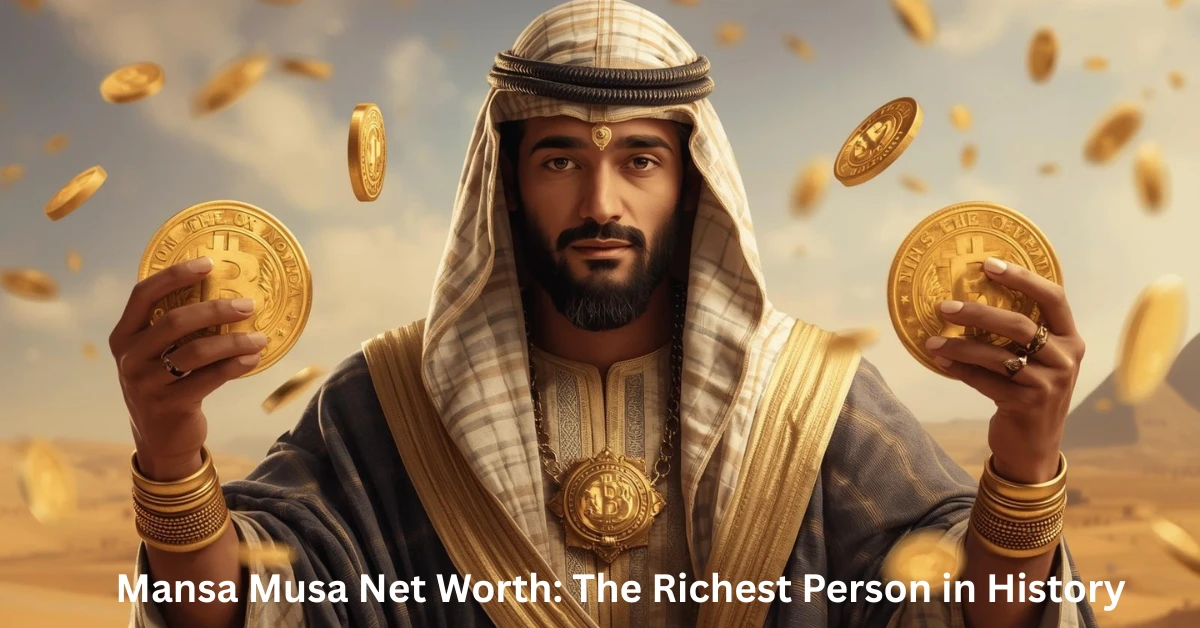
Mansa Musa’s net worth is considered legendary, making him one of the richest individuals in history. As the 14th-century emperor of the Mali Empire, his wealth came from vast gold reserves, thriving trade networks, and strategic governance of one of Africa’s most prosperous empires. Historians estimate Mansa Musa’s fortune to be around $400 billion in today’s dollars, making him wealthier than any modern billionaire, including Elon Musk and Jeff Bezos.
His legendary pilgrimage to Mecca further showcased his riches, as he distributed gold so freely that it reportedly caused inflation in cities along his route.
But his net worth wasn’t just about gold; it symbolized the political power, economic influence, and cultural richness of Mali. Understanding Mansa Musa’s wealth offers insight into the grandeur of medieval African empires and the enduring legacy of a ruler whose fortune continues to captivate historians and the world today.
Who Was Mansa Musa?
Mansa Musa, also known as Kankan Musa, ruled the Mali Empire from 1312 to 1337 and is remembered as one of the most powerful and wealthiest monarchs in history. The Mali Empire, located in West Africa, was rich in natural resources, especially gold, which was the main source of Mansa Musa’s fortune. Under his reign, Mali became a hub of trade, culture, and Islamic scholarship, attracting merchants and scholars from across Africa and the Middle East.
Mansa Musa’s legendary pilgrimage to Mecca in 1324 revealed the staggering scale of his wealth to the world. Contemporary travelers described caravans carrying thousands of attendants, camels laden with gold, and generosity that temporarily devalued gold in Cairo and other cities.
To help understand his net worth in modern terms, here’s an estimated comparison:
| Source | Estimated Net Worth (in USD) |
| Modern historians’ calculation | $400 billion |
| Inflation-adjusted medieval wealth | $300–500 billion |
| Comparison with top billionaires today | More than Elon Musk & Jeff Bezos |
Mansa Musa’s wealth wasn’t just for personal luxury; it fueled massive construction projects, including mosques and educational institutions, and established Mali as a center of learning and culture. His reign left a lasting legacy, showing that wealth, when combined with governance and vision, could transform a region into a global powerhouse.
Sources of Mansa Musa’s Wealth
Mansa Musa’s extraordinary net worth was the result of multiple revenue streams that made the Mali Empire one of the richest regions in the medieval world. The most significant source of his wealth was gold. Mali was home to some of the largest gold mines of the time, producing vast amounts that were highly sought after across Africa, Europe, and the Middle East. Controlling these resources gave Mansa Musa immense financial power and global influence.
Another key source was trade. The Mali Empire was strategically located along trans-Saharan trade routes, facilitating the exchange of gold, salt, ivory, and other valuable commodities. Mansa Musa taxed these trades heavily, collecting revenue from merchants passing through his empire. This system not only increased his personal wealth but also enriched Mali as a whole.
Governance and tribute also played a major role. Conquered territories and vassal states were required to pay taxes and provide gifts, further expanding his fortune. Mansa Musa used this wealth strategically, funding public works, mosques, universities, and Islamic scholarship. His investments strengthened the empire’s economy and left a lasting cultural legacy.
Historians today estimate that his combined wealth from gold, trade, and governance could have reached $400 billion in today’s terms, making him arguably the richest individual in recorded history. His fortune was not only vast in scale but also influential, shaping the economic, cultural, and religious landscape of West Africa for generations.
Mansa Musa Net Worth Estimates
Estimating Mansa Musa’s net worth is challenging because no precise records exist from the 14th century. However, historians and economists have made educated guesses based on his gold holdings, trade revenue, and the size of the Mali Empire. Most estimates place his fortune at around $400 billion in today’s dollars, making him possibly the richest individual in human history. Some scholars suggest a range of $300–500 billion, depending on how historical gold values and inflation are calculated.
To put this in perspective, Mansa Musa’s wealth surpasses the combined net worth of many modern billionaires. For example, as of 2025, Elon Musk is worth approximately $200 billion, and Jeff Bezos is valued at about $150 billion. Even the richest people today would rank below Mansa Musa if his wealth were converted into current USD.
| Comparison | Net Worth (USD) |
| Mansa Musa (14th century) | $400 billion (est.) |
| Elon Musk (2025) | $200 billion |
| Jeff Bezos (2025) | $150 billion |
| Bill Gates (2025) | $120 billion |
These estimates illustrate not only the size of his fortune but also the economic power of the Mali Empire. Mansa Musa’s net worth wasn’t just wealth for personal luxury; it funded massive infrastructure projects, educational institutions, and cultural landmarks. Understanding these figures helps us appreciate the scale of his influence and why Mansa Musa’s net worth remains a topic of fascination centuries later.
Comparison with Modern Billionaires
When discussing Mansa Musa’s net worth, one of the most striking points is how it compares to today’s wealthiest individuals. Adjusted for inflation, Mansa Musa’s fortune of around $400 billion far exceeds the net worth of modern billionaires. For context, Elon Musk and Jeff Bezos, two of the richest people today, have net worths of approximately $200 billion and $150 billion, respectively. Even the combined wealth of the top five richest people in the world would not equal Mansa Musa’s estimated fortune.
Mansa Musa’s wealth wasn’t limited to money; it included vast gold reserves, land, trade influence, and economic control over the Mali Empire. In contrast, modern billionaires largely rely on stock holdings, businesses, and investments. This makes Mansa Musa’s fortune remarkable, as it was tied directly to natural resources, strategic trade routes, and governance.
| Wealth Comparison | Net Worth (USD) |
| Mansa Musa (14th century) | $400 billion (est.) |
| Elon Musk (2025) | $200 billion |
| Jeff Bezos (2025) | $150 billion |
| Bill Gates (2025) | $120 billion |
By comparing historical and modern wealth, it becomes clear that Mansa Musa was not only rich but also globally influential. His fortune allowed him to finance monumental projects, promote education, and strengthen Mali’s economy. Unlike modern billionaires, whose wealth fluctuates with markets, Mansa Musa’s net worth represented real, tangible control over one of the most prosperous empires of the medieval world.
The Legendary Pilgrimage to Mecca
One of the most famous events showcasing Mansa Musa’s net worth was his legendary pilgrimage to Mecca (Hajj) in 1324. This journey not only demonstrated his devotion to Islam but also displayed the staggering scale of his wealth to the world. Historical accounts describe a caravan of 60,000 men, including soldiers, officials, and attendants, accompanied by camel loads of gold, luxury goods, and gifts.
Mansa Musa distributed gold generously along the route, giving it to the people with low income, local leaders, and even foreign rulers. In Cairo, his donations were so immense that they reportedly caused a temporary devaluation of gold, affecting the local economy for years. Cities along his journey witnessed an unprecedented display of wealth, cementing his reputation as the richest person in history.
| Pilgrimage Highlights | Details |
| Date | 1324 |
| Caravan Size | 60,000 people and 12,000 slaves |
| Gold Carried | An estimated hundreds of tons |
| Economic Impact | Temporary inflation in Cairo and Medina |
| Cultural Significance | Strengthened Mali’s global reputation |
Beyond wealth, the pilgrimage enhanced Mali’s influence, attracting scholars, traders, and diplomats to the empire. Mansa Musa’s journey was not only a religious act but also a global display of economic and cultural power, making his name synonymous with extraordinary wealth and leadership. Today, this pilgrimage remains a vivid example of how a single ruler’s fortune could impact economies and societies far beyond his own empire.
Economic Impact of Mansa Musa’s Wealth
The enormous wealth of Mansa Musa had far-reaching effects on both the Mali Empire and the regions he interacted with. Within Mali, his gold reserves, trade control, and taxation policies strengthened the empire’s economy. Cities like Timbuktu, Gao, and Djenné flourished as centers of commerce, attracting merchants from North Africa, the Middle East, and Europe. The influx of wealth allowed for the construction of mosques, universities, and marketplaces, turning Mali into a hub of learning, culture, and trade.
Mansa Musa’s spending during his pilgrimage to Mecca had notable external effects as well. In Cairo, for instance, the sudden influx of gold led to temporary inflation, decreasing the value of gold for several years. This demonstrates how a single ruler’s fortune could influence regional economies in the medieval world.
| Economic Impact | Details |
| Internal Development | Infrastructure, mosques, and schools |
| Trade Expansion | Boosted trans-Saharan commerce |
| Cultural Growth | Patronage of Islamic scholarship |
| Regional Economic Effect | Gold inflation in cities visited |
| Global Reputation | Mali is recognized as wealthy and powerful |
Mansa Musa’s wealth was not idle; it served as a tool for nation-building and global influence. By investing in education, culture, and infrastructure, he created an enduring legacy that elevated Mali’s status in the world. His fortune shows that immense wealth, when managed strategically, can reshape societies, economies, and even international perceptions of a region.
Cultural and Educational Legacy
Beyond his wealth, Mansa Musa’s impact on culture and education remains one of his most enduring legacies. Under his reign, the Mali Empire became a center of Islamic scholarship and learning. He invested heavily in the construction of mosques, madrasas, and libraries, particularly in cities like Timbuktu and Gao, which became hubs for scholars, scientists, and poets from across Africa and the Middle East.
The Djinguereber Mosque in Timbuktu, built during his rule, is a prime example of his architectural and cultural contributions. These institutions not only facilitated religious education but also promoted literacy, mathematics, astronomy, and law, shaping the intellectual foundation of the region for generations. Mansa Musa’s patronage attracted scholars and students, turning Mali into one of the most educated and culturally advanced societies of the medieval world.
| Cultural Contributions | Details |
| Mosques & Madrasas | Djinguereber Mosque and others |
| Libraries & Scholarship | Promotion of learning in Timbuktu |
| Arts & Architecture | Islamic-inspired architecture, city planning |
| Cultural Influence | Attracted scholars and traders globally |
| Long-Term Legacy | Timbuktu as a historical center of knowledge |
Through these investments, Mansa Musa ensured that his empire’s prosperity extended beyond gold and trade. His vision of combining wealth with education and culture elevated the Mali Empire’s global reputation, proving that the power of knowledge and learning could be as influential as economic might.
Fun Facts and Legendary Tales
Mansa Musa’s extraordinary wealth gave rise to numerous fun facts and legendary stories that continue to captivate historians and the public alike. One of the most famous tales comes from his pilgrimage to Mecca, where he reportedly carried so much gold that he caused inflation in Cairo, temporarily lowering the value of gold for years. This story illustrates not just his wealth, but also the global impact of his fortune.
Travelers described Mansa Musa’s caravan as an astonishing sight, including 60,000 attendants, 12,000 slaves, and hundreds of camels laden with gold and luxury goods. His generosity extended beyond political influence; he gave gold to the people with low income, gifted treasures to rulers, and distributed money to communities along his route, leaving a lasting impression of Mali’s prosperity.
Other fun facts include:
- Mansa Musa’s wealth inspired legends in Europe and the Middle East, with some maps marking Mali as a “land of gold.”
- Despite his riches, he was known for piety and generosity, using wealth to support religious and educational institutions.
- His name became synonymous with extreme wealth, influencing stories and myths that lasted centuries.
| Legendary Highlights | Details |
| Gold Inflation in Cairo | Caused by his generous distributions |
| Massive Pilgrimage | 60,000 attendants and hundreds of camels |
| Global Recognition | Mali is marked as “the land of gold” on maps |
| Legacy of Generosity | Supported schools, mosques, and people with low incomes |
| Lasting Myths | Stories of unimaginable wealth |
These stories make Mansa Musa’s life both historical and legendary, demonstrating that his wealth wasn’t just a number; it shaped economies, cultures, and global perceptions for centuries.
Why Mansa Musa’s Net Worth Still Matters Today
The story of Mansa Musa’s net worth remains relevant centuries later because it illustrates the power of wealth combined with vision and leadership. Unlike modern billionaires, whose fortunes often fluctuate with stock markets, Mansa Musa’s wealth was tangible, derived from gold, land, trade, and governance. It allowed him to transform an entire region, making the Mali Empire a hub of culture, commerce, and learning.
Mansa Musa’s net worth also highlights Africa’s historical economic power, challenging the misconception that the continent was economically insignificant before European colonization. His fortune enabled massive infrastructure projects, educational institutions, and cultural developments that influenced societies far beyond Mali. Cities like Timbuktu remain symbols of intellectual and cultural achievement, demonstrating how wealth can be leveraged for societal growth.
| Modern Relevance | Explanation |
| Economic Lessons | Shows how resource management fuels prosperity |
| Cultural Influence | Promoted scholarship, arts, and architecture |
| Historical Context | Highlights Africa’s medieval economic power |
| Global Inspiration | Serves as a benchmark for extraordinary wealth |
| Legacy of Leadership | Wealth used for nation-building, not just personal luxury |
Furthermore, Mansa Musa’s story continues to inspire historians, economists, and educators. By examining how his wealth shaped a society, we gain insight into effective leadership, resource management, and cultural investment. His legacy proves that extraordinary wealth, when paired with strategic vision, can leave an enduring impact that lasts far beyond a ruler’s lifetime.
FAQs:
- How rich was Mansa Musa?
Mansa Musa’s wealth is estimated at around $400 billion in today’s dollars, making him the richest person in history. - What made Mansa Musa so wealthy?
His fortune came from gold mines, trade routes, taxation, and governance of the Mali Empire. - Did Mansa Musa’s wealth affect the global economy?
Yes, his pilgrimage to Mecca caused temporary inflation in Cairo due to the massive distribution of gold. - How does Mansa Musa compare to modern billionaires?
His estimated wealth exceeds that of Elon Musk, Jeff Bezos, and Bill Gates, even combined. - What did Mansa Musa do with his fortune?
He invested in mosques, educational institutions, cities, and Islamic scholarship across the Mali Empire. - When did Mansa Musa rule Mali?
He ruled the Mali Empire from 1312 to 1337, leading it to unprecedented prosperity. - Why is Mansa Musa famous?
Apart from his wealth, he is known for his pilgrimage to Mecca, generosity, and promotion of education and culture. - What is the legacy of Mansa Musa today?
Cities like Timbuktu remain symbols of his contributions to culture, learning, and trade. - Was Mansa Musa’s wealth only in gold?
No, his wealth included land, trade influence, taxation, and natural resources, making it far more than just gold. - Why is Mansa Musa’s net worth still studied?
It demonstrates historical African economic power, strategic leadership, and the long-term impact of wealth on societies.
Conclusion:
Mansa Musa’s immense net worth was more than a measure of personal wealth; it was a reflection of the power, culture, and prosperity of the Mali Empire. Estimated at around $400 billion in today’s terms, his fortune surpassed even the richest modern billionaires, demonstrating the scale of economic influence one ruler could wield in history. His wealth was strategically used to build mosques, educational institutions, and cities, transforming Mali into a center of learning, trade, and culture that attracted scholars and merchants from around the world. Even today, Mansa Musa’s net worth continues to captivate historians, economists, and curious minds, reminding us that true wealth lies not only in gold or possessions but in how it is used to shape the world. His reign remains one of the most remarkable examples of leadership, generosity, and historical impact.